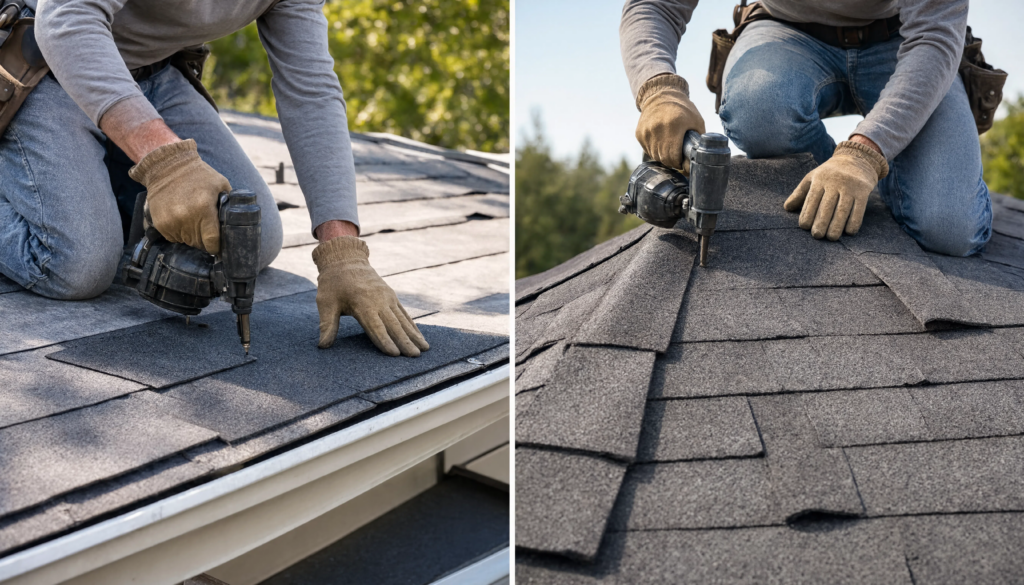
When homeowners look at a new asphalt roof, their attention naturally goes to the shingles covering the large, visible sections.
But the shingles at the very bottom and very top of the roof have different jobs to do.
Starter shingles are installed along the roof edges, while ridge cap shingles protect the peaks and hips where roof planes meet. They may blend into the finished roof, but they are designed and installed differently from the shingles covering the main surface.
Starter Shingles Begin the Roofing System
Starter shingles form the beginning course along the eaves and, depending on the roofing system, the rake edges.
Their location is important because roof edges are particularly exposed to wind. Purpose-made starter shingles typically include adhesive positioned to help secure the first course of shingles and reduce the chance of wind getting underneath the edges and lifting them.
They also work alongside the drip edge, gutters, fascia, and soffits to help protect some of the most vulnerable areas along the roof edge.
Ridge Caps Protect the Highest Points
At the other end of the roof are the ridge caps.
These shingles cover ridges and hips, where two roof planes meet. Because they have to conform to those angles, ridge cap shingles are designed specifically to bend over these areas while protecting the joint underneath.
They also help defend these exposed areas from wind-driven rain, snow, and other weather. Depending on the product, ridge caps can complement the color and dimensional appearance of the shingles covering the rest of the roof.
On roofs with ridge ventilation, the caps also finish and protect the area above the ridge vent.
Why Not Just Use Regular Shingles?
Years ago, cutting standard three-tab shingles for use as starter strips or ridge caps was common.
Today, roofing manufacturers offer purpose-made components for these locations. Starter strips place adhesive where it is needed along the edges, while manufactured ridge caps are designed for the shape and exposure of hips and ridges.
Using roofing components for the jobs they were designed to perform helps the different parts of the roof work together as a high-performance roofing system.
The Details Are Easy to Miss From the Ground
Once installation is complete, homeowners may never notice where the starter shingles end or exactly how the ridge caps differ from the shingles below them.
That is exactly how it should look. These components should blend naturally into the finished roof while performing their specialized jobs.
A well-installed roof depends on more than choosing the right shingle color or style. The components at the edges, peaks, penetrations, and transitions all play a role in protecting the home.
At Len Roofing & Remodeling, we look at the entire roofing system rather than treating every shingle as though it serves the same purpose.
The Len Roofing & Remodeling Difference
When we say that we’re a top-quality home remodeling and roofing company that serves the North Shore and surrounding Chicagoland area, we back it up. We do more than simply cover the basics: we show up on time and nail it.
For more information or to schedule a consultation, call 847-768-6000 or visit our contact page.